
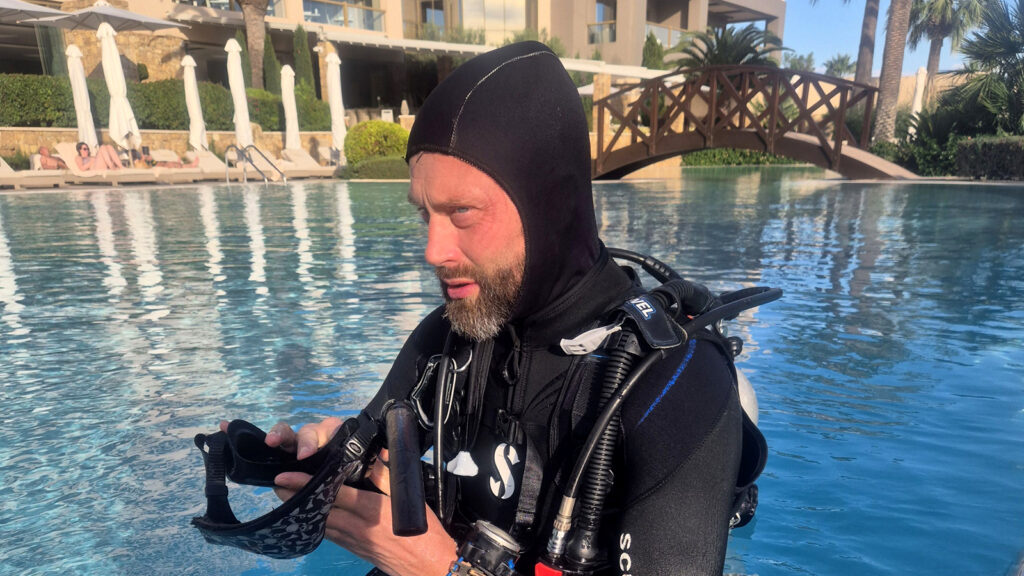
Reflections of a PADI Course Director after another Instructor Development Course
The Emotional Toll of an IDC
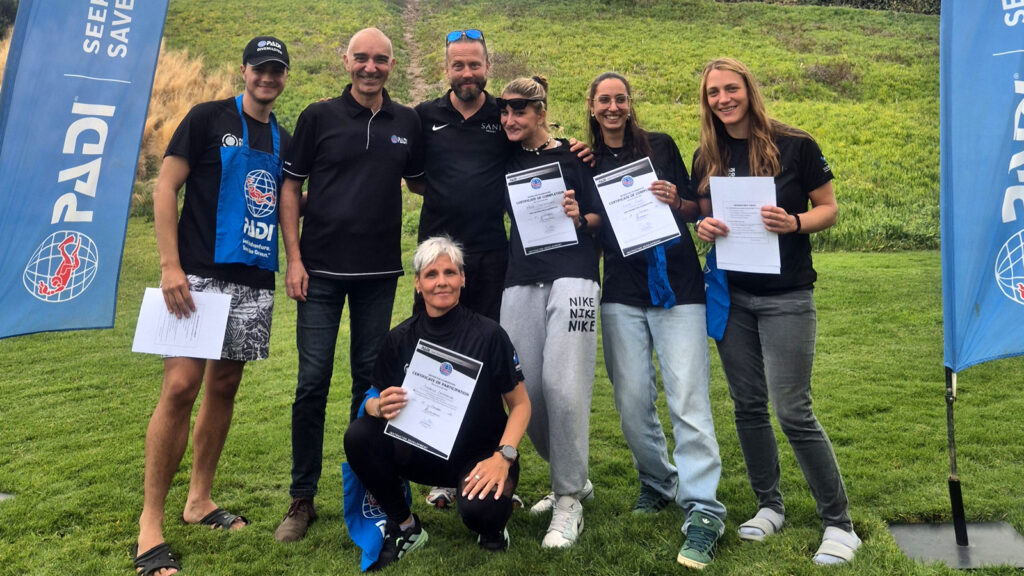
I have just finished teaching another PADI Instructor Development Course (IDC) and it took immense emotional toll on me. This time in the group of six candidates there were five women and one man — together with an IDC Staff Instructor candidate. Seven people in total, each with a different personality, background, story, and reason for being there.
Our candidates came from Greece, Germany, Austria, and France, while our Staff Instructor candidate came from Italy. Their ages ranged from 19 to 56. Some were at the beginning of their adult lives, while others had already experienced careers, responsibilities, disappointments, and successes that had shaped who they were.
On paper, the group was adequately prepared in theory and a little better than average in practical skills. There was a good foundation to work with. But an IDC is never just about theory, dive skills, presentations, standards, and examinations.
An IDC is about people.
And working with people at such an important moment in their lives comes with an emotional toll that we, as Course Directors, do not always talk about openly.
More than a diving course
People choose to become PADI professionals for different reasons. For some, becoming an instructor is the natural next step in their diving journey. For others, it is an opportunity to develop themselves personally, gain confidence, or prove something to themselves.
And for many, it is a life-changing decision.
Some candidates see the IDC as the beginning of a completely new career. Others want to escape a professional environment that no longer makes them happy. Some are looking for adventure, independence, or a chance to turn their passion into a way of life.
Whatever their motivation, they arrive carrying much more than dive equipment and study materials.
They bring their expectations, fears, insecurities, personal problems, ambitions, and sometimes years of self-doubt. They arrive with an image of the professional they want to become, but they may not yet have the confidence to believe they can become that person.
As a Course Director, I have a responsibility to recognise these differences and provide the best possible coaching and mentoring.
My responsibility is not simply to prepare candidates to pass an examination. It is to help them develop into competent, confident, responsible diving professionals.
That responsibility is a privilege. But it can also be mentally exhausting.
The pressure of examinations — and the pressure of being responsible
An IDC is an intense experience for candidates. They must absorb a considerable amount of new information in a relatively short time, apply standards correctly, demonstrate practical skills, deliver presentations, receive criticism, and prepare for their Instructor Examination.
They are constantly being observed and evaluated. Every presentation can feel like a judgment of their abilities. Every mistake can become evidence, in their own minds, that they are not good enough.
I have seen the euphoria after a successful presentation. The smiles, laughter, high-fives, hugs, and sudden release of tension can transform the atmosphere in a room.
I have also seen tears after an unsuccessful performance.
The same person who was confident an hour earlier can suddenly lose faith in themselves. A relatively small mistake can feel enormous when someone believes that their entire future depends on getting things right.
This is one of the most emotionally demanding aspects of teaching professional courses. You are not just correcting an incorrect answer or demonstrating a better technique. You are trying to help someone separate a temporary performance from their personal worth.
A candidate can perform poorly without being a poor future instructor. A difficult presentation does not erase months or years of diving experience. One unsuccessful attempt does not define a person’s potential.
But when anxiety takes over, these distinctions become difficult for candidates to see.
And that is when the Course Director’s role becomes particularly demanding.
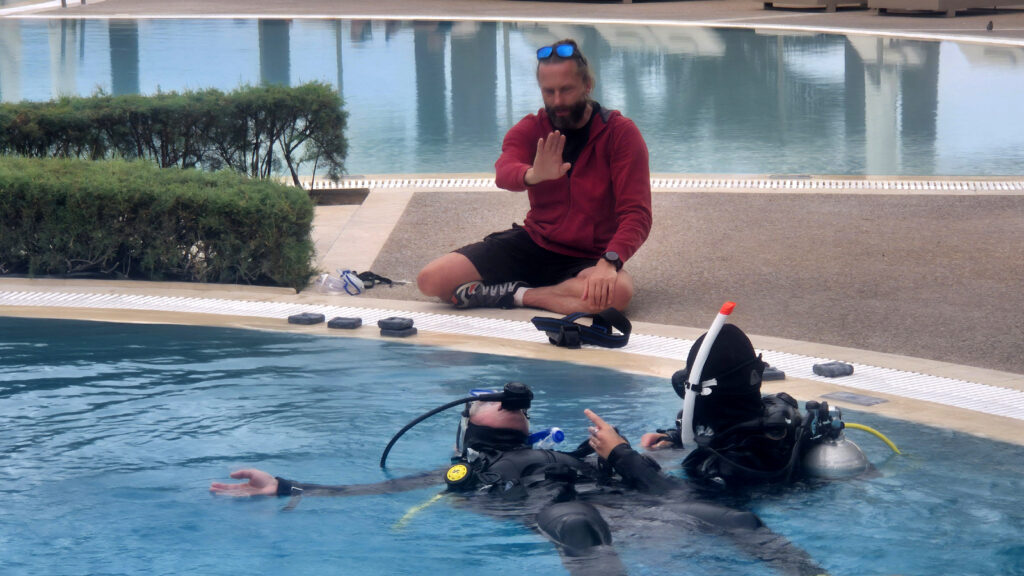
The emotional responsibility of a Course Director
There is a particular kind of pressure that comes from feeling responsible for your students’ performance.
You prepare the schedule, organise the training, explain the standards, demonstrate the skills, and provide feedback. You monitor progress and try to identify weaknesses before they become serious problems.
You repeat information. You explain it differently. You demonstrate again. You ask questions, encourage, challenge, reassure, and sometimes insist.
You do all this while constantly asking yourself whether your approach is helping each individual candidate in the best possible way.
Could I have explained that better? Was my criticism too direct? Did I give enough positive feedback? Should I have challenged this candidate more, or should I have allowed them more time? Did I recognise that this person was struggling before their performance deteriorated?
These questions follow you throughout the IDC.
The responsibility becomes even more complicated when you genuinely care about the people you teach. You want them to succeed, but you also know that passing an examination is not the only objective. You need them to become safe, capable professionals who understand the responsibility they will eventually have towards their own students.
Encouragement without honesty is not good teaching. Neither is criticism without empathy.
Finding the balance between the two requires constant attention, patience, and emotional energy.
And sometimes, at the end of the day, there is very little energy left.
Different people need different approaches
One of the most interesting aspects of this recent IDC was the diversity of the group.
Seven people from four countries, with ages ranging from 19 to 56, brought different communication styles, expectations, levels of confidence, and ways of responding to pressure.
Culture matters. Age matters. Previous professional experience matters. Personality matters.
Some candidates respond well to direct, precise criticism. They want to know exactly what went wrong and what they must do to improve.
Others need time to process feedback before they can use it productively. A direct comment that motivates one person can discourage another.
Some candidates openly express their frustration. Others withdraw into silence. Some laugh when they are nervous. Others become defensive. Some immediately ask questions, while others need encouragement before they feel comfortable admitting that they do not understand something.
There is no single coaching technique that works equally well for everyone.
As Course Directors, we have to adapt. We need to understand when to challenge, when to reassure, when to explain again, when to step back, and when to make it clear that a particular standard cannot be compromised.
We also have to manage our own communication.
Professional language, a controlled voice, an appropriate tone, and a calm presence are essential. Even when we are tired, frustrated, or concerned, we must communicate in a way that supports learning.
Maintaining that professional presence throughout an intensive course takes effort. You cannot simply allow your own frustration to dictate how you speak to someone who is already struggling.
The irony is that the more emotionally demanding a situation becomes, the more important it is to remain calm and professional.
And the harder it can be to do so.
” There is a monster floating just under the surface, and I can’t allow it to rise its head above”
The invisible work of giving feedback
Criticism is easy. Effective criticism is not.
A Course Director must identify what needs to improve without destroying the candidate’s confidence. We must recognise what went well while being honest about what did not.
This sounds simple until you have delivered your tenth critique of the day, repeated the same explanation several times, and watched a candidate make the same mistake again.
Frustration is a natural human response.
But our job is to ensure that frustration does not become the message.
We need to remain focused on the candidate’s next step rather than our own disappointment. We need to explain what can be changed, why it matters, and how the candidate can improve.
Positive feedback is not about making everyone feel good. It is about helping candidates recognise their strengths so that they can build on them. It is about giving them a realistic picture of their progress, not allowing their insecurities to define it.
This requires concentration.
It requires emotional discipline.
And it requires us to keep looking for something constructive, even when the candidate in front of us is struggling to see any progress at all.
Sometimes the most important thing a Course Director can do is help a candidate recognise that they are improving when they genuinely believe they are failing.
At other times, it is equally important to explain that confidence alone is not enough and that a particular skill or standard needs more work.
Both conversations can be difficult. Both are necessary.
Personal demons, perfectionism, and insecurity
An IDC has a way of bringing personal insecurities to the surface.
When people are tired, under pressure, and constantly evaluated, the barriers they normally manage to hide can become much more visible.
Some candidates struggle with perfectionism. They expect every presentation to be excellent, every answer to be correct, and every performance to meet their own very high expectations.
When that does not happen, they become their own harshest critics.
Others struggle with the opposite problem: they do not recognise the seriousness of their mistakes because they are afraid to confront their limitations.
Some candidates interpret constructive feedback as a personal attack. Others assume that a disappointing result means the Course Director has lost confidence in them.
Sometimes, a candidate’s internal struggle becomes more significant than the actual training challenge.
This is where coaching can become emotionally draining.
You can explain the standards, provide examples, demonstrate the correct technique, and offer practical steps for improvement. You can be patient, supportive, and available.
But you cannot do the internal work for another person.
You cannot force someone to believe in themselves. You cannot eliminate every fear. You cannot make someone accept feedback before they are ready to hear it.
You can guide them, but they must eventually take responsibility for their own learning.
Accepting this is important for the Course Director’s own psychological well-being.
Our responsibility is to provide the best possible conditions for learning, not to control every emotion, every reaction, or every outcome.
That distinction can be difficult to remember when you genuinely want every candidate to succeed.
Group dynamics: a small society under pressure
An IDC group is more than a collection of individuals. It becomes a small society, with its own relationships, alliances, frustrations, humour, and emotional atmosphere.
Over the course of the programme, people begin to understand each other. They celebrate successes, share disappointments, and gradually discover each other’s strengths and weaknesses.
There are hugs, high-fives, jokes, and moments of genuine solidarity.
There can also be foul language, raised voices, misunderstandings, and conflicts.
Gender dynamics, age differences, personality clashes, and different communication styles can influence how people interact. Male–female, male–male, and female–female relationships within the group can each develop their own patterns.
Sometimes, candidates support each other beautifully. Sometimes, comparison becomes a problem.
One person’s success can inspire another candidate, but it can also trigger feelings of inadequacy. Someone who receives praise may become more confident, while someone who is struggling may feel increasingly isolated.
A candidate’s frustration can spread through the group. Equally, one person’s calmness and encouragement can help everyone recover after a difficult session.
As Course Directors, we must pay attention not only to individual performance but also to the emotional climate of the group.
We need to encourage mutual support without allowing candidates to become dependent on one another’s approval. We need to recognise when a disagreement is simply part of working together and when it begins to interfere with learning.
And we must remember that each candidate is experiencing the IDC from their own perspective.
What seems like a minor issue to one person can feel overwhelming to another.
Managing these dynamics requires attention even when we are already mentally exhausted from teaching, evaluating, and planning.

When the Course Director becomes emotionally exhausted
There is a point during an intensive professional course when the accumulation of small demands begins to weigh heavily.
It is rarely one dramatic event.
It is the combination of repeating the same information, monitoring everyone’s progress, adjusting feedback, preparing the next session, maintaining professional communication, resolving misunderstandings, and carrying the emotional weight of other people’s expectations.
It is listening carefully to a candidate who is convinced they have failed, while remembering that another candidate needs your attention and that the next session must begin on time.
It is trying to remain encouraging when someone is discouraged, firm when someone needs boundaries, and objective when your own emotions are involved.
It is knowing that the group needs you to be present, focused, and consistent, even when your mental reserves are running low.
This is the invisible workload of teaching PADI Professional Courses.
The physical workload is real, too. There are long periods in the water and underwater, often in cold or uncomfortable conditions. There is equipment to manage, practical training to supervise, and repeated demonstrations to perform.
Physical fatigue makes everything else more difficult.
When you are cold, tired, and mentally overloaded, maintaining the same level of patience and concentration takes even more effort.
Meanwhile, candidates are processing large amounts of new information in a short period. They are learning, practising, presenting, making mistakes, receiving feedback, and preparing for examinations.
Everyone is tired. Everyone is under pressure.
But the Course Director must still create an environment in which learning remains productive and professional standards remain clear.
That is a demanding combination.

The emotional burden of the Instructor Examination
As the IDC approaches its conclusion, the atmosphere changes.
The Instructor Examination becomes increasingly real. Preparation turns into anticipation, and anticipation becomes anxiety.
For candidates, the examination represents the final test of everything they have worked towards. It may represent a new career, a major financial investment, a personal milestone, or a decision that has been developing for years.
The pressure is not merely about passing or failing.
It is about what they believe the result will mean for their future.
As Course Directors, we must prepare candidates as thoroughly as possible while helping them understand that examination anxiety is normal.
We must encourage confidence without creating false expectations. We must be honest about their readiness while ensuring that fear does not obscure their actual abilities.
And we must accept that, despite our best efforts, we cannot guarantee the outcome.
That may be one of the hardest parts of the job.
We invest time, energy, knowledge, and emotion in preparing our candidates. We want to see them succeed. We want them to walk into the examination feeling prepared, capable, and proud of what they have achieved.
But the examination is ultimately their responsibility.
Our role is to prepare them, guide them, and give them the tools to perform to the best of their abilities. We cannot take the examination for them, and we cannot remove every uncertainty they feel.
Learning to accept this boundary is essential.
The responsibility goes beyond passing
There is another side to this responsibility that should never be forgotten.
A newly qualified instructor will eventually have students of their own. Those students may be nervous beginners, inexperienced divers, or people placing their trust in someone else’s professional judgment.
The way we train instructors can influence how they teach, how they communicate, how they respond to mistakes, and how they treat the people who depend on them.
That is why standards matter.
A Course Director cannot allow the emotional desire to see a candidate succeed to replace an objective assessment of their competence.
We must support candidates as people while evaluating their performance as professionals.
These two responsibilities belong together.
Empathy does not mean lowering standards. High standards do not require a lack of empathy.
In fact, the most meaningful coaching often comes from combining the two: being honest about what must improve while making it clear that improvement is possible.
When we do this well, we help candidates develop not only the skills required to become instructors but also the ability to accept feedback, manage pressure, and continue learning throughout their professional lives.
Those lessons may prove just as valuable as anything they demonstrate during an examination.
What this IDC reminded me
Looking back at this group of six IDC candidates and our IDC Staff Instructor candidate, I am reminded once again that every course is different.
The theory may be familiar. The standards may be established. The presentations may follow a structured format. The practical exercises may be repeated from one IDC to the next.
But the people are never the same.
Each candidate brings a different combination of experience, ability, motivation, and vulnerability. Each group develops its own rhythm. Each IDC presents new challenges that cannot be solved simply by following a schedule.
And each course asks something of the Course Director that goes beyond technical knowledge.
It asks for patience, emotional intelligence, adaptability, and resilience.
It asks us to remain professional when we are tired, to stay constructive when we are frustrated, and to keep believing in the value of the learning process when candidates temporarily lose confidence in themselves.
It also asks us to recognise our own limitations.
We cannot be everything to everyone. We cannot solve every personal problem or remove every internal barrier. We cannot guarantee that every candidate will achieve the result they want.
What we can do is show up, prepare thoroughly, teach honestly, listen carefully, and offer the best coaching and mentoring we can.
Sometimes, that means celebrating a breakthrough.
Sometimes, it means having a difficult conversation.
And sometimes, it means accepting that a candidate needs time, additional practice, or a different approach before they are ready to move forward.
All of these are part of professional development.
A final thought: who looks after the Course Director?
We often talk about the emotional pressure experienced by IDC candidates. We discuss examination anxiety, confidence, performance, and the challenge of meeting professional standards.
We talk less often about the emotional toll on the people responsible for guiding them through the process.
Course Directors are professionals, but we are human beings, too.
We feel responsible. We worry. We question our decisions. We sometimes replay conversations in our minds, wondering whether we could have handled a situation differently.
We feel the disappointment when a candidate struggles. We feel the tension when group dynamics become difficult. We feel the responsibility of preparing someone for a profession in which other people’s safety will eventually depend on their judgment.
And when the course finishes, the emotional work does not necessarily end with the final presentation.
Sometimes, we need time to decompress, reflect, and recover. We need to acknowledge that caring deeply about our students is both a strength and a source of emotional strain.
We need to learn that being a good Course Director does not mean carrying every candidate’s anxiety on our own shoulders.
It means giving people the tools to manage their own challenges while providing guidance, structure, and support.
For me, the real reward of an IDC is not simply seeing candidates pass an examination.
It is seeing people grow.
It is watching someone who was afraid to speak in front of a group deliver a confident presentation. It is seeing a candidate accept criticism without taking it personally. It is watching individuals who initially compared themselves with others begin to support each other instead.
It is seeing people recognise that they are capable of more than they believed when they first arrived.
These moments make the long days, the repeated explanations, the difficult conversations, the cold water, and the mental exhaustion worthwhile.
But they do not make the emotional toll disappear.
Perhaps we should talk about that more openly.
Because teaching PADI Professional Courses is not only about developing diving professionals. It is also about navigating human emotions, managing expectations, and taking responsibility for an experience that can genuinely change someone’s life.
And while we work hard to prepare our candidates for the challenges ahead, we should remember to look after ourselves, too.
We are not just teaching people how to become instructors. We are helping them take the next step in their lives. That is a privilege worth protecting — and a responsibility worth acknowledging.
Marek Koszorek
PADI CD #649856